Friday, September 20, 2013

Mollusk Muzik #7 OR There aint more thing to climb

Re: Vi Hart. Big fan, big big fan!(1) Turns out she likes watching snails, too!(2) And writing tear-jerking ballads about frustrated snail aspirations. 


Vi Hart
"There aint more thing to climb"
(2012)


Moving ... albeit slowly. If you enjoyed this video, you might also enjoy the prequel. These videos were at the top of my list of results for the search "Crazy Snail".


References and Miscellany:
(1) If you don't know why, watch these. If, after watching these, you still don't know why, we're done here. 

(2) I mean "too" in the sense of "like me" rather than "in addition to doing everything else she does"

Tuesday, September 17, 2013

On Freeing Whales OR Oh! What Misfortune to be Charismatic Megafauna

As I have previously indicated, I was a big supporter of the Free Willy/Keiko effort in the 1990's. While there are many things from that part of my life that I am happy I can shrug off as "growth", I'm actually proud of my 10 year old, or whatever I was at the time, self, because I think the cause was worthy and the outcome was not a failure.

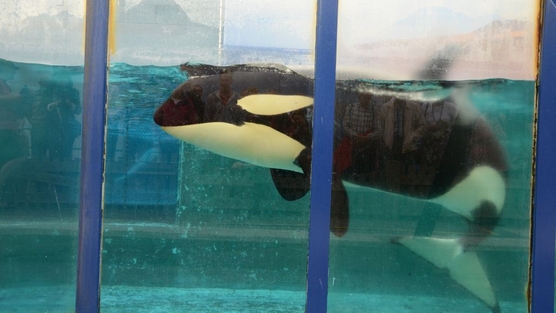
There have been a few recent attention-grabbing news items focusing on whether orcas should be kept in captivity. In addition to the documentary, Blackfish, there has been an outcry (and OUTCRY) about the commodification of an orca named Morgan (Figure 1). that was supposedly in rehab after being stranded on the Dutch coast. 

Figure 1. Don't worry, Morgan, we're doing it because we love you! And that makes it ok. Photo: Change.org


These events have apparently reminded the collective consciousness (the media?) of the only orca for whom we have (so far?) had an attention span sufficient actually follow through on a plan for release into the wild. I really like this NYT video on the history and fallout of that story. Also, Craig McCaw, who knew?


Sorry for the sober interruption of what is usually a giddy exploration of science, folks. We will return to our regularly scheduled programming shortly.


Thursday, September 12, 2013

Species species of the Week week #9 OR Artisan Beach Shovels

Hang on to your hats and prepare to be astounded by amazing sea life!


You know this week's tautonym as "The Billion $ bivalve", "The Chlam with the Charisma", "A Hell of a Shell", 

That's right, ladies and germs, this weeks tautonym is none other than:

Mercenaria mercenaria

Sorry if I got your hopes up, it's not my fault! With the rare exception, clams just make for soul-crushingly boring pictures. If I led with that picture you probably would have just browsed away to watch a cat climb into a fish bowl(1). 

Ok, so thanks Blue Planet, now everyone thinks that the only cool things in the ocean are stunningly beautiful. But we know better right? Heck yes, we know better! Beauty is on the inside (Figure 1).

Figure 1. ACK No, beauty is not there either! Christ, that's gross! Make it stop, I'm eating my lunch here! 
I'm kidding, I don't think it's gross, and that could very well be your lunch. Not mine, though, I don't eat gross things like that.  I mean, of course, that it's INTERESTING. But not worthy of narration by Oprah I guess. Photo credit: R. Koss, U. Alberta

In fact, you probably already (and if you don't you soon will) appreciate M. mercenaria for the following reasons:
  • The most common common name(2) of this clam is Quahog. If you don't get why that is relevant to anything ever, suck it up and click on the link and get with the times.
  • The large shells make great artisanal, locally-sourced digging tools at the beach! (Figure 2)
  • It's one of the most widely consumed clam species(3) in the US. If you've had actual New England clam chowder, this species is a likely candidate for the gummy bits that make you wonder whether you are actually eating bits of your exercise band from pilates class.
  • It is the state shell of Rhode Island, and, yes, state shells are a thing. And don't act like you're surprised that states have such arcane totems, states got everything!
  • An individual M. mercenaria was dated as the LONGEST LIVED ANIMAL!
Figure 2. I really should be paid for my graphic design skills


So, aside from the list of quasi-interesting marginalia, these shells aren't much to look at.   But I did find a few interesting pictures of what are supposedly Mercenaria mercenaria shells (Figs 3 and 4)

Figure 3. From Roger Williams Univeristy.

Figure 4. From asnailsodyssey.com, which you should check out

Notice the cool patterns? That reminded me of a clam that shares the common name of "littleneck" with M. mercenaria.  The Japanese littleneck, which is also called the Manila Clam (Venerupis philippinarum) is part of the same family of clams, and is also important in aquaculture. I talked to shellfish growers a few years ago who were extremely excited they had figured out how to control some of these shell patterns (Figure 5, also, WOAH). And I'm all like, wow, thats so cool, so you can tell if your clams have wandered onto a neighboring bed (like branding cattle!), and the grower was all like, "yeah, I guess, but really it just makes them more appealing at the market." So, lesson learned people, don't be fooled into paying higher prices for a pretty clam.

Figure 5.  Not a tautoym, but indeed a good lesson in why color is not a good character to use to tell species apart - at least in invertebrates


ERRATUM!: It turns out the oldest clam reference is not Mercenaria mercenaria, but another quahog (which makes sense given the arctic distribution). I just assumed (and you know what they say about assuming) that since they said quahog, and didn't give a species...well, serves me right.  BUT it turns out that clam was 100 years older than they thought it was.  Thanks, Hillary B. for providing me with the truth.


References and miscellany:

(1) Ok, now you've gone and done it and off you are on your little voyage down the cat video rabbit hole - enjoy! and don't miss out on Maru.
(2) New blog series? Common common names?  Post it on Tuesday or some horrific day of the week like that? But srsly, there are a bajillion common names for this species, and more than a few synonymized scientific names as well. 
(3) God I thought current mixologists had gone off the deep end - seriously, this is a terrible idea.

Thursday, September 5, 2013

This just in.... Sea stars dying?

It's not often that anything seems like I should post it with any speed, snails don't move that quickly after all, but this does seem to be a story in progress, and relevant to the marine life of the PNW:

Divers in B.C. and off the WA coast have noticed massive die-offs of subtidal sea stars recently.  

Figure 1. I didn't want to shock anyone with pictures of dying sea stars, so this is just a wikimedia photo of a Pycnopoida, one of the species in the die-off.

Here is a link to a post on Echinoblog about it.  Warning, graphic pictures of dead and dying sea stars (including zombie arms that keep walking even with no other part of the animal left! Need future post on autotomy in echinoderms!).

Lots of speculation about possible causes:
  • Low dissolved oxygen?
  • Major freshwater input = salinty stress (it has been pouring in Seattle every night for a week)?
  • Wasting disease?
  • Poachers slicing and dicing or bleaching?
  • Combination thereof?

Mollusk Muzik # 6 OR 10,000 View Celebration Dance Party!

I ran out of songs for a while for this Mollusk Muzic series, but thanks to my dear friend Jan, I noticed that this is close enough to count. Also I [not so] secretly really like Donovan, who, I might add, was recently inducted into the Rock and Roll Hall of Fame, probably for his recent work in advocating for ocean conservation.  

I have to say that I love this video, because it is clearly the kind of music video I would make if I were to apply myself to using Power Point slide show with timing and soundtrack.


Donovan
"First, There is a Mountain"
(1967)

I dare you not to dance just a little bit. 


Also, my blog evidently has 10,000 views as of today!  Hooray!

It's admittedly almost entirely driven by image searches for orcas and Strongylocentrotus droebachiensis.  Never underestimate the value of tags friends!  


Thursday, June 6, 2013

Species species of the Week week # 8 OR Tautonomical Beach Adventure Times!

The faithful among you will recollect that months ago I alluded to an upcoming blog post featuring surprise organisms from my trip to New Zealand.  Well that time has arrived!  I went on a couple of stellar walks in the Waitakere Ranges just west of Auckland. On a hike back along the black sand of Karekare beach, I was stunned to see this breath-taking site (Figure 1):

Figure 1. Oh for God's sake, she's going to make us look at more shells.


I know, right?!

Ok, but look more closely (Figure 2): 
Figure 2. Hmm.  This purple slightly depressed globose shaped shell with countershading reminds me of a blog post I wrote once...

HECK YES! Back when I wrote that post about how awesome the aviator snail/Baggins snail (Janthina janthina) is, I didn't ever expect to actually see it. I wasn't even really paying attention, or reading my field guide closely enough to realize I might see it. When I walked out onto the beach and saw them all strewn about like so much flotsam and jetsam, I had to pick my jaw up off the ground long enough to take some photos!


But, lo! What else have we here (Figure 3)?

Figure 3. Why, we have a planar equiangular spiral shell approximately 3cm at the widest diameter, Charming for sure, but, Emily, why do you show us this beauty? That's right, because it's a tautonym!

Oh no f in way!  This lovely segmented shell is that of: 

Spirula spirula!

A cephalopod ("head-foot", people) resembling a squid(1), the organism itself is actually quite adorable (Figure 4). 


Figure 4. Tiny!  The shells I found were about 2-3 cm in diameter, which means the actual  S. spirula was much larger than this one.  You can see the internal shell toward the top right of the photo, oriented perpendicular to the camera. Photo from deapseanews.com.


Unlike most mollusks, S. spirula(2) doesn't use this shell for protection, but for buoyancy regulation. Much like in the external shell of a nautilus (nope, this one), the chambers are separated by septa(3) and connected by a long cord called the siphuncle  (Figure 5, soooo many figures!).

Figure 5. Shell anatomy of S. spriula ("rams horn shell"). The siphuncle regulates the gas pressure in each chamber, allowing S. spirula to maintain neutral buoyancy at whatever depth it is found.
(Image from http://www.metafysica.nl/ after Clarkson 1979 Invertebrate Paleontology and Evolution)


The animal usually floats head- (and tentacles/arms-) down, and there is a light-sensing organ on the end of the mantle (above the shell in Figure 4). They live deep (~1,000m) during the day and migrate closer to the surface (~100-300m) to feed at night.  This helps them avoid things with eyes that would like to eat them during the day - like fish. This is an EXTREMELY long daily migration: 90,000 body lengths each way! JEEZUM, that is like a human swimming from Philadelphia to New York and back every night, not accounting for traffic!(4)

Actively swimming this distance would require 1x10^23 bowls of Wheaties(5). How does S. spirula manage without the Breakfast of Champions ("...and so on")? Aha! This is where the shell comes into play: S. spirula can reduce pressure in the chambers of the shell, increasing buoyancy, and the animal can pop up like a scuba diver (well, safely, of course), without having to waste energy swimming. Hopping on the elevator instead of taking the stairs - amiright? There's a theory that Sperm whales use spermaceti to help them sink in a similar way(6).

There's some uncertainty about these guys' range. When they die, the shells often float to the surface and can drift really far. So who knows where those shells on the transcendent black sand beaches of paradise-I-mean-New-Zealand came from? Anyone in NZ want to offer me a postdoc? Worth a shot.


References and Miscellany:

(1) Perhaps surprisingly, at least to me, in spite of how similar this shell is in structure and function to that of a Nautilus, molecular evidence suggests that Spirula is more closely related to other squids and octopusses/octopodes than to Nautiluses, and relatively recent addition to the cephalopods. The shell appears to be an ancestral character that has been lost in many of the other cephalopods, but maintained and internalized in Spirula and in a somewhat altered form in Sepiida (cuttlefish).

(2) Incidentally Spirula spirula (Linneaus, 1758) is indeed the only member of the genus Spirula, all other taxa having been synonymized, lending support to my theory of tautonyms - just sayin'.

(3) Yeah, Philadelphia, you know what I'm talking about.

(4) I think. I'm new at these comparison things that science communication people say are so effective at making numbers less abstract. Here's my logic: I figured 900m vertical distance divided by 3cm body length (figure 4) is 90,000 body lengths. A human is roughly 5.75m, 90,000 human body lengths is ~98mi. But looking around to figure what that people have an idea of that is 98 miles is the hard part, and truthfully, google says it's only 96.3mi, but really you get the idea. Holy Michael Phelps, Batman! Actually, that dude is a sprinter, here is the real long distance heroine.

(5) OK, that number I just made up.

(6) Clarke 1970 Nature. 228:873.

Tuesday, June 4, 2013

Shameless Serial Promotion OR Lay off, man, I've been busy!

Figure 1. Simbeliebers


I just went to visit my two year-old niece on the East Coast, and when I showed up, she was so excited she ran figure eights around the kitchen table and island (I wish I had an animated gif to add here, but you can probably just imagine one). On the plane home, belted into my own personal 9 cubic feet of space inside a floating tin can, I felt driven to similarly unconstrained expressions of excitement and over-stimulation when I read Dan Simberloff & Co.’s recent TREE review on the current role of invasion science.  Thankfully for my own dignity, nothing squelches feelings of unbridled joy quite so much as sitting in the back of an economy airline cross-country flight (Thank God and Bose for noise-cancelling technology).

So I wrote a li'l piece for the Graduate Student Blog Biodiverse Perspectives.

Enjoy!