Saturday, January 19, 2013

Walkabout Missive #4 OR Viva La Hermit Crab Proletarian Revolution!

After all the New Zealand excitement was over, you'd think that was enough, right?  Wrong! Time for Costa Rica!  

You're in luck with respect to my Costa Rica trip:
  1. Because the camera got broke by a vicious Marbled Wood Quail (Figure 1) immediately upon taking the camera out to take the first picture of the trip, and:
  2. Because I actually saw almost no marine organisms. And I have 0 pictures of marine organisms.
Figure 1. Marbled Wood Quail.  Not my picture, because, as you can clearly tell, these birds socialize to plot the demise of tourist soul-capturing devices such as the nefarious Panasonic Lumix Zs20s. 

Oh but don't even for a second imagine that you are off the hook.  Because you are about to have to endure my amazement at seeing:

A Hermit Crab Conga Line!

Figure 2. Hermit crab conga line! At first I thought I made that term up and no one should repeat it, but now I've read it elsewhere so that's officially what this is called. Also, apologies that this picture was clearly taken by my phone. Costa Rica had its revenge however, and oxidized the contacts on my phone's charging port and now the phone won't turn off. You win, tropical humidity, you win.
Ok, so check this out (Figure 2). There are at least 4 hermit crabs (1) in order of descending size lined up trying to forcibly evict the largest hermit crab (not visible because it's hiding quaking in that luxury shell). The idea is that it's dangerous for a hermit crab to be shelllllless because the abdomen, which you typically can't see, is all gross and vulnerable (eew), and because they basically become french fries to birds when they aren't protected by their shells. So, in this efficient system, they latch onto someone who has a more spacious shell equipped with all the modcons, and wait for the bloodshed to start. No, really! Well, maybe "bloodshed" is a bit hyperbolic, but "Conga Line" is rose-tinting it for sure. This is survival on the line here and it is a scenario of a social enforcement of reappropriation/liberation of valuable goods (2)

IT'S A HERMIT CRAB PROLETARIAT REVOLUTION!

I'd have taken a video of this, but the process takes forever, because that 1% guy in the big shell is smart and just tries to wait for the violent 99% mob to tire themselves out and get bored and go back to taking soma and watching reality TV shows.

I had totally heard of this phenomenon, it's not new to science. But I didn't really believe it could be true - sure maybe someone saw some hermit crabs in a group once somewhere and projected some story on them, but NO, this was happening ALL OVER THE BEACH. There is such a high density of hermit crabs on these black sand tropical beaches (3) that shells are likely in short supply.  

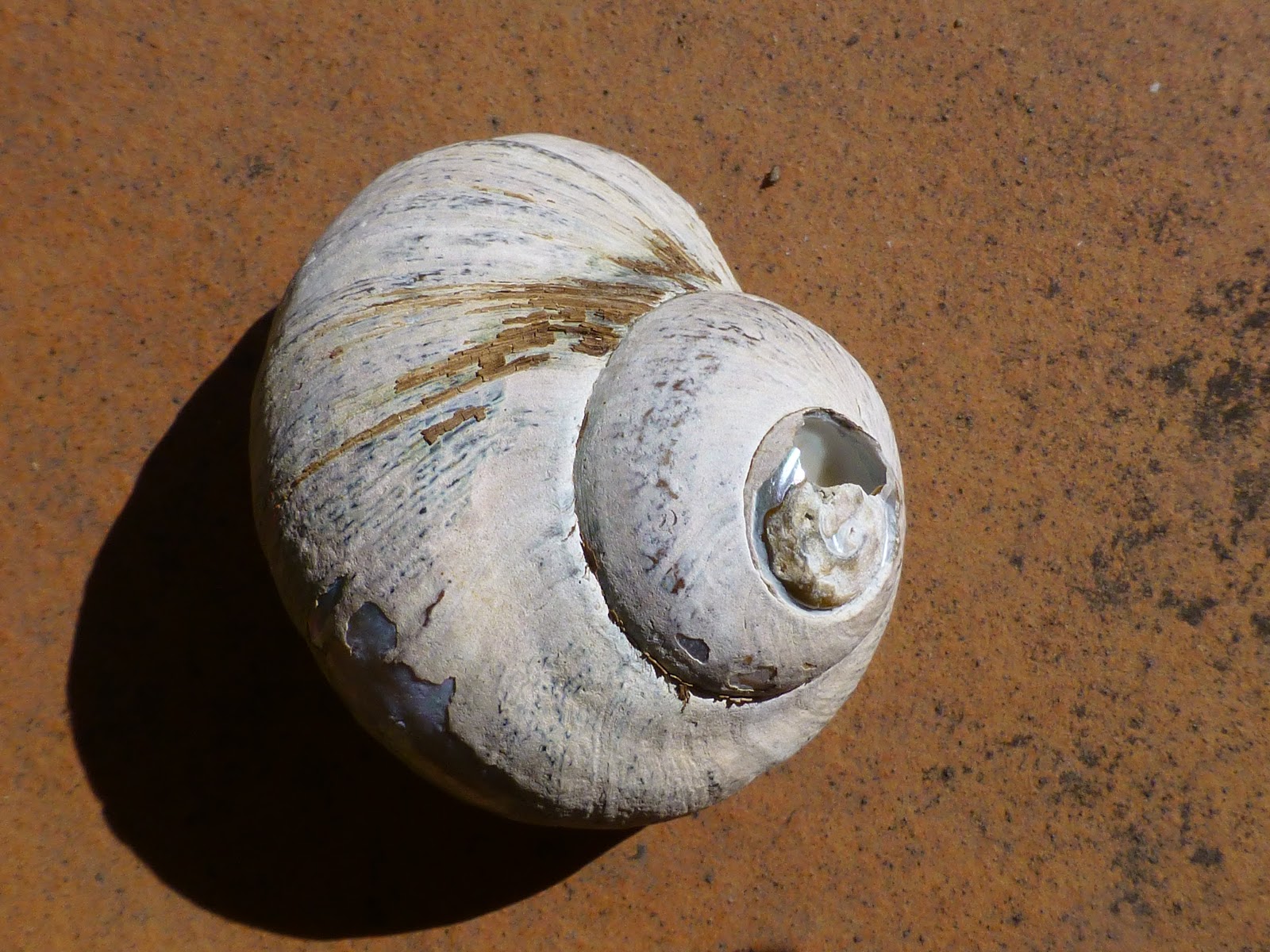
These crabs had the COOOLEST SHELLS (Figs 3 & 4), but I never saw the actual snails that made them. 

Figure 3. Turritella leucostoma (I think?).
I have got to start adding scale bars to my shell photos.  Bush league, Grason.

Figure 4. Whelk.  You'd think since I study whelks I'd be better at identifying them,
but my current resources - thanks Google images, don't really give me much to go on.

OK, that's all I have to say about hermit crabs, but check out these awesome other arthropods we saw!

Figure 5. Lady Elephant Beetle!  With finger for scale.  This one was dead at the visitors center at Corcovado National Park, but freshly dead - she had goo still all up in her.

Figure 6. STAG BEETLE (!!!). This doesn't look impressive except the nail
head is about 1cm across for reference. This guy accepted our eager invitation
to dinner one night, hence the napkin, but evidently didn't feel
welcome and took off almost immediately after.
Figure 7. Check out those sparkly baby blues!
Figure 8. Whiptail Spider (Amblypigi) This was our nighttime bathroom buddy.  Evidently he's only a little guy (though easily probably 6-8" across at those whips) because we saw several much larger on a nighttime hike.  We also had some bats take up residence in our bathroom closet each night. 


Sleep tight! Don't let the giant beetles bite!


References and miscellany:
(1) You'll recall from when you got your first pet hermit crab from that sketchy boardwalk souvenier shop that pet hermit crabs are actually not marine, they are land crabs, and will die if you submerge them in water.  Though they do require some water source to keep their gills wet so they can breathe. There are indeed marine hermit crabs, we got heaps up here in the PNW, but the ones crawling around on the beaches in Costa Rica are terrestrial.
(3) Not to make you jealous, but srsly, these beaches were tropical commercial beautiful. 

Thursday, January 3, 2013

Walkabout Missive #3 OR Falling Off the Face of Middle Earth


I'm not going to pretend I didn't fall off the face of the earth there for a bit - Middle Earth to be precise, and then paradise after that. So, there is some catching up to do. Truth be told, I am writing this at gate 6 at John Wayne Airport on my way back to Seattle and it's evidently been almost exactly 27.5 days since I gave a second thought to my laptop, which was a fantastic Christmas gift (the lack of second thought, the laptop itself was not a Christmas gift).  

BUT, there is work to be done! I must report on my updated NZ adventure list. Then there is the Costa Rica adventure list (which, for reasons to be detailed later, is blessedly  un-photodocumented). I went tidepooling SOOO many more times since the last blog post. I seem to have been lucky enough to stumble on a bunch of relatively good daytime lows while I was in NZ.  

NZ SHELL FIELD GUIDE - PART DEUX


OK, first this assemblage of shells that were just SITTING ON THE BEACH in Akaroa on the Banks Peninsula. Is there such an obscene abudance of beautiful nature in this country that they can afford to just leave literal heaps of perfect shells untouched on a public beach?!

Figure 1. Turrett shells (Maoriculpos roseus), about 3" long. My friend Tasha has some on her Kiwi Christmas Tree.

Figure 2. Yeah, another whelk that I had trouble identifying. Evidently, there are just a lot, so no one place tries to cover them all.  I'm going to take a stab at this one and guess Xymene ambiguus (good species name for a NZ whelk), the large Trophon ?

Figure 3. Cat's Eye Turbo (Turbo smaragdus)  Oh, dear, that can't be right. No, that's right, only now it's evidently in the Lunella genus.  Whatever.

After the South Island, we went to the War Museum in Auckland, which it turns out has huge awesome drawers full of specimens, including this non-marine vertebrate that I can't not put here (Figure 4, apologies for cell phone photo).

Figure 4. Ok, it might not be NZ per se, but it is horrid.

And, I didn't get any great pictures of this, so I'll subject you to a crummy one: They had an awesome, and clearly under appreciated, room on the intertidal in this museum. The dusty displays were arranged by intertidal zone (Figures 5 and 6) to look natural. They did a great job, because these zones are basically where I found this stuff!  SWOOOOOON.


Figure 5. Low-Mid intertidal shells on a mock-sandy shore.  I totally found many of these shells right where they said I would.

Figure 6.  Mid-Upper intertidal zone in same exhibit.  Note Turrett shells in top left!

OK are you totally sick of this vacation slide show yet? 

TOO FREAKING BAD! HERE'S MORE PICTURES OF INVERTEBRATES!


Figure 7. Woah terrifying huge funnel web!  Non-marine, but definitely awesome.


Figure 8.Wheel Shells! Zethalia zelandica. Ok, they don't look like they deserve an exclamation point in my photo.  But they are extremely impressive in real life! I swear! Here is a much better picture of what they look like in situ (when I forgot to take a picture - evidently).  You know, it's a good think I'm only NOW finding this other site, which will actually probably help me ID things I've found. But scope these guys in Figure 6 - mid-high intertidal sandy beach. I found these at Karekare beach (more on that later), which, you might like to know, is also featured in The Piano.

Then I went on this rad sailing trip in the Hauraki Gulf.  

Figure 8. Whaaat?!!! Why yes, that is a beautiful porcellanid crab from Kawau Island!

Figure 9. And 2 beautiful black neritas (Nerita melanotragus) also on Kawau. These were all on a really beautiful bed of rock oysters.

Let's see, what else have we got...


Figure 10.  Oh heck yes! A lovely cushion star on Tiri (= Tiri Tiri Matangi - an amazing conservation island. If you're ever in Auckland, take a day trip out there and see more awesome birds - Giant chickens? - than you ever thought possible.  I'm not going to show any birds here though)

Figure 11. And ooh, another rad Chiton! Chiton glaucus
Figure 12.  Kina (urchin) are a much favored food for Maori and Kiwis.  Urchins, however, are evidently not much favored by writers of shell field guides and so weren't in my book. Any guesses?
Figure 13. Yup another whelk I can't identify.  Also on Tiri at Fisherman's Cove in the arches.
Figure 14. This oystercatcher has a spine (meaning vertebral column, not like a pokey outy bit - which would be its bill), but is also really enjoyable to watch, so, for all of you who made it this far, you get a gift of seeing some "charismatic megafauna" 


And, lastly, a gimme for those of you who like plants/beautiful scenery

Figure 15.  Every once in a while, I did look up from the ground. View from Tiri.  Pohutukawa (NZ Christmas tree) in foreground

OK, and one more little late Christmas gift:


This now concludes our tour of NZ Shell fauna (oh, except two surprises I'm reserving for later...)

Hei kona


References and Miscellany:
You're in luck! There is no fine print (this bit notwithstanding).  Just pretty pictures today!


Thursday, December 6, 2012

Christmas Present #2 OR Red Rock Crabs Rampage

About this time last year, I found out my first paper had been accepted.  Today, I got my second academic Christmas present (hint: it's not a pony, either).

My second, and final, paper from my Master's work was published today in PLoS ONE.  

Woohoo!

That means it's open access, and you can download your very own copy for free!


If you prefer to read my editorialized summary in a more...engaging?...voice, I wrote a little thing for SciPos, UW Biology's Grad Blog. 


Wednesday, December 5, 2012

Walkabout Missive #1 OR Local Colour

In an attempt to escape the inevitability of a SAD Seattle winter, I've fled to the Southern Hemisphere for a few weeks.  Actually, I've fled the Northwest for the rest of the year. I've been staying with my friend Tasha, who is doing a Ph.D. at Lincoln University on non-native clovers (more later?)! As we've explored her field sites, digging along roadsides because science is nothing if not glamorous, we've also been able to explore some EXTREMELY rad intertidal places. We stopped over at Taylor's Mistake (Figure 1), a little cove east of Christchurch.  
Figure 1. Taylor's Mistake? As in, "Whoops, this place is fantastic"?
Like a good little naturalist, I had the foresight to spend a bit much on a field guide. With the notable exception of the gaping hole in the shape of arthropods, this book has been pretty helpful.  So, here I'll do my best to give you a little tour by proxy. Feel free to let me know if you've noticed something I've gotten wrong. I've also tried to include the Maori names where they are available.

Local Faunae

You've already noticed the mussels, perhaps?  I counted 4 species: carpets of Little Black Mussels/Kuku (Limnoperna(1) pulex - Figure 2), Blue Mussels/also Kuku(2) (Figure 3, Mytilus galloprovincialis) which, I'm sure you've already noticed, are familiar for being invasive in the PNW; Green-lipped mussels/again, Kuku (Perna canalicula - Figure 4) , which have the distinction of being one of the prettiest mussels I've ever seen. I also espied, but naturally have no photodocumentation of, ribbed mussels/kuku, too?(3) (Aulacomya maoriana).

Mussel Beach


Figure 2. Yeah, no shortage of mussels.  Little Black Mussels/Kuku.

Figure 3. Beaucoup kuku. Black and Blue mussels. 

Figure 4. NZ Green-lipped mussel (+ friend, snakeskin chiton, Sypharochiton pelliserpentis)


And speaking of gastropods, let's not forget the snails...

Figure 5. This is absolutely a whelk, but beyond that, I'm really not certain on this one. Nothing I've found in the guide or online is quite right for this one. Any guesses? But you can scope the Banded Periwinkles (Austrolittorina antipodum) on the mussels in the top right.

Figure 6.  Oh I got this one, Beaded top shell - Calliostoma punctulatum

Figure 7.  Top shell and two Cook's Turbans/Karaka (Cookia sulcata). These snails were all live and just hanging out on the sand! Don't you know?! You guys are too cool to be so accessible!
Figure 8.  Nudi-eggs?


And lest you think I was entirely mollusk-o-centric:

Figure 9. Anemones!  Dunno what they are, couldn't get a good enough view...definitely some symbiodinium up in there though.

Ok, last two.  These were from Brighton Beach, a bit north.

Figure 10.  Dosinia anus (snicker)/Harihari, I think? It was such a cool, flat shell.  I'm just a little bit obsessed.

Figure 11. These carapaces were all over the beach.  My best guess is the New Zealand Paddle Crab (Ovalipes catharus)

And here's the scene at Brighton Beach (4):

Figure 12. Ok I swear this is the last one.  You can just see Kaikoura (I think) looking north.


OK - Ima go find some more stuff...


References and Miscellany:
(1) Double-checking taxonomic status of names on WoRMS, the guide gives the genus as Xenostrobus, but WoRMS says Limnoperna is the accepted genus.

(2) From what I can tell, using the Te Papa site, there are lots of Maori names for these things, but the generic mussel name seems to be "kuku". 
(3) These might also be called "kopakopa" which is also used to refer to other shells that are "ribbed"
(4) It was really windy, and the sand was very fine at Brighton. I might have permanently damaged my new camera...Thanks Tasha for lending me your camera and some pictures as well...

Friday, November 16, 2012

Mollusk Muzik #5 OR data analysis be damned!

Unfortunately no actual video for this one. I was going to make a slideshow of PNW marine snails to watch while playing this song, but I found something better! Check out Kevin Lee's website of really beautiful pictures of PNW gastropods. In the top-right corner, there's even a "slideshow" feature. (It's abalone heavy toward the beginning, if you want to skip ahead to snails, they get going around page 5). You can play this song in the background as you let the slideshow auto-advance, and drink your mid-morning coffee...at least, that's how I'm spending my Friday morning - data analysis be damned!

Swear and Shake
"Humming to a Sea Snail"
Album: Maple Ridge

Monday, November 12, 2012

SCAD (Scientific Conference Affective Disorder)

I was at a conference this weekend. I sat through a million and a half talks this weekend.  I sat through a million and a half talks about marine biology this weekend(1).  I sat through a million and a half talks about marine biology in MONTEREY, CALIFORNIA this weekend.

And not a single one mentioned this...


Thanks, Ryan, for keeping me abreast of the latest. 

Of course, conferences are great ways to get excited about all the cool work that's going on in your discipline - but they are freaking long, even when they're short, and there are all these other people there - saying stuff!   But I really feel like I should at least find a few of the fun things I heard about to share with those of you who weren't able to make it.


Here are some highlights:


  1. Mangroves are actually invasive in Hawai'i (2).  It's really somehow disarming when you find out a species that is normally of conservation concern in one (or many) place is targeted for eradication in another. Ecology is all about context, people.
  2. Concrete reef balls OR BUST! Last Christmas, a family friend gave me the awesomest gift of a donation to the Chesapeake Bay Foundation, supporting oyster restoration via concrete reef balls. Robert Dunn(3) gave a talk suggesting that the use of non-calcium carbonate based substrates for making oyster reefs (like concrete) might help reduce the colonization by a boring (4) sponge. The sponge is attracted to calcium carbonate, because it eats its way through oyster shells (which are made of calcium carbonate), which is obviously bad news for oysters. 
  3. Arts and crafts are alive and well in marine ecology.  I get the greatest pleasure at seeing the creativity and ingenuity applied to ecological experiments, maybe because that's one of my favorite things about doing it. Wandering around the Home Depot, or JoAnn Fabric, looking for inspriation and trying to explain to the well-intentioned, but out-of-their-depths, customer service folks what you are trying to accomplish with the goods available for purchase at their store (5).  This weekend I saw a robot attack shark, an eelgrass bed made of yarn and polypropylene tape, a toy octopus attacking a real hermit crab. 

Lowlights:

  1. We might have been outdanced by The Filipino Nurses Association, which was sharing the conference facility. At least their party started earlier, and they were better dressed.
  2. The irony of going to Monterey for a marine ecology conference and spending literally 96 times as much time in a conference room with my butt in a chair than I spent in the amazing local marine environment. I realize I am largely to blame for this.  It is a choice.
  3. Absolutely nobody really agrees with anyone else on ecological modelling.


Also did you know that, in places outside of Seattle, it's sometimes sunny and warm?! EVEN in November?!  I know, CRAZY! But look (figure 1), I have proof!


Figure 1.  On arrival in the bay area, I realized I had been deceived by
Seattle's plummeting descent into the dark abyss of winter (6).  It turns out
 the sun DOES still actually rise - at least in California.


References and Miscellany:
(1) Ok, fine, this might be an exaggeration. I did go for a walk on the beach one day. Also I saw a talk on efforts to conserve the California Condor, which can't, strictly speaking, be included in that number if it' s not marine. I was particularly excited to see this talk because it's one of the rare ones at this conference that isn't about benthic marine ecology. 
(2) Megsie Siple, now at SAFS
(3) For whom I can't find any direct links, sorry.
(4) Zzzzz....Right, not that kind of boring.  "Boring" meaning making holes, people! Sponges are not uninteresting, did you not just see the video I posted?!
(5) "You want to do what with orange sparkly tulle?"  But seriously, thank you to all the folks who have patiently attempted to help me.
(6) It's surprising to me that Natalie Dee isn't from Seattle. She nails it.


Tuesday, November 6, 2012

Holy Undiscovered Charismatic Marine Megafuana, Batman!

Did you guys see this?!


I know! Nuts! There exist species of whales that haven't even been seen before!? SRSLY?! Good GOD!

I was jonesing for some real information, so here, I found the journal article and you can get it for free - including a drawing (all the pictures in the media are of the species of beaked whale that it was originally confused for, so I didn't even bother to put it in here).

It's at Te Papa! So is this!