Showing posts with label mudflat olympics. Show all posts

Saturday, April 2, 2016

Grinnin' and pickin' OR From the Annals of Never Again Cited Research

Exhibit A. The author, birthday princess, destroys crustaceans as celebration ritual. Date? Let's just say: pre-Y2K.
At right, the one remaining shot glass I can find. There was definitely an "I got crabs in Maryland" one at some point.
A lot of people, especially in the PNW, love crabs because they are tasty, but, and here is a confession that I hope nobody ever finds out: I don't eat crabs [anymore]. I grew up in Maryland and every year for my birthday we'd pick blue crabs. I remain fiercely proud of that part of my heritage, as evidenced my collection of unused shot glasses. But by college I had phased all meat, including seafood, out of my diet. My crab-picking skills, earned at the cost of a thousand million cuts to that sensitive part of my fingers between the nail and last knuckle, seasoned with Old Bay and left sizzling for days(1), are moot, a party trick at best.

I love crabs because they are fierce, because they have personality, and they have a rep for holding it down in the intertidal. I enjoy feeding crabs by hand because I'm a total weirdo, and I find it completely satisfying. Here, you watch this and tell me if I'm crazy.


Super intense, right!?(2)

There are numerous examples in the literature of crabs keeping snails at bay by just straight up eating them. Thus, you might surmise, if you have read way back in this blog to the part where I used to write about actual science that I actually did, that I would be reeeeeeeally curious to see if crabs would eat any of my invasive snails - in particular my favorite Mollusca Non-Grata, the Japanese oyster drill (Ocenebra inornata(3)). Previous research, done by,  *cough cough*, yours truly, pointed to at least a willingness of crabs to eat these snails when you throw them in a bucket together. But that's frankly pretty unimpressive - crabs will eat anything you throw them in a bucket with. What happens in natura(4)?


It was just like this...Photo of the author in her natural habitat
Credit: Nima Yazdani.
Answering that question was the goal of my summer of 2011. And if you're wondering, gee, Emily, that was HALF OF A DECADE AGO, why are you telling us about this now? It turns out half a decade is exactly how long it took me to get this work published(5)!

I'll set the scene: Emily, way out on a beautifully restored native oyster bed on only the sunniest of sunny PNW days, clean and well rested, scratching her chin and waxing genius about ecological dynamics of restoration.


J slash K. It was nothing like that. I had so much generous help. Second off, it never looked like I had it together out there even for a second. Field work is a slog. When you do work in the intertidal, it's a panicked slog, as you race to get your work done before the tide comes back. In the muddy intertidal, it's a panicked slog in painful, hilariously clumsy, slow motion as you race against the returning tide ankle deep in mud. I consider myself relatively fleet of foot in moving across mud in waders, but it's not pretty, I assure you.

So I called for help. I had a slew of helpers: 

  • Nima, a classmate's husband, who was interested in seeing what the work of scientists actually looks like. He took the beautiful picture above.  I'm grateful not to have seen any close ups of what I actually looked like that day. 
  • Avanthi, a classmate's girlfriend (now wife :) ), who was an amazing trooper, helping me swap out oysters on very little sleep as I recall. 
  • Marie, my actual classmate, she and I carried approximately 17 million tons of rebar down the shore and across the mud - how we did it, I can't remember. I think it was one of those, well, there's really no one else who's going to do it if we don't - moments.
I also had excellent logistical support from a number of people:
  • Brian Allen at Puget Sound Restoration Fund helped me get access to the oyster beds, which were under PSRFs restoration care - they put out old oyster shell to provide habitat for new babies to settle on. Brian also tried his best to teach me to pilot a tiny Whaler with an outboard, and I discovered that there are some skills that I need more than 2.5 minutes to learn. To this day, I cannot operate an outboard.
  • Joth who gave me sacrificial oysters from his own farm! That's right, the shirt off his back to support graduate research. 
  • Molly and her father Greg, who helped ferry me said oysters.
  • Jen, my advisor, who taught me how to make oyster pops, and helped me secure lots of random supplies for building cages. "Sure, you need 20 old oyster bags? I'll have Alan bring them up and leave them outside Kincaid". 
  • Not LEAST, Dave and Sue, the amazing couple who not only helped me get beach access from shore (note previous comment about inability to learn how to pilot a boat), but invited me in for coffee (pre tide flat) and soda (post tide flat) multiple times. Seriously, I can't tell you how much I love meeting the lovely shoreline owners!
This list doesn't even include my co-author Eric, who stuck it out with me through a long writing, rewriting, analyzing, re-analyzing, revising, and, yes, re-revising, which was evidently so traumatic that it caused his lung call it quits and spontaneously collapse. Sorry, Eric.

So that picture where I'm out there looking like John Muir on my own doing science and looking ruggedly picturesque - that's not what it's like. This is a list of 11 people who made this one tiny(6) experiment possible, and that doesn't include the grad students who reached deep into their closets and donated as many wire hangers as they could muster (which, naturally, I didn't end up needing...), and Alan who drove the oyster bags up from Willapa, and Eddie who tolerated the mess I made on the loading dock, and the guy who stole all the rebar from the loading dock - wait that last one maybe doesn't need a thank you.

But you get the point. It takes a village people, this is how the sausage is made, and now the paper is published (Link here click on me, I am a link and I will take you to Emily and Eric's paper, and you clicking on me will increase the paper stats! Even if you don't think that sort of thing should be important, it is. So click on me, come on, why haven't you clicked yet? Seriously, you read this far and haven't clicked? For Shame! <--Did you find the Easter egg in there? is it an Easter egg if I tell you it's in there?). 

In classic Emily style, I managed to get my act together to write this post only too late to give you access to the paper via the temporary open access link. Now it is paywalled (but you can email me). So I'll have to write another post where I tell you what all the fuss was even for, but first, I have to remember.

TUNE IN NEXT TIME TO FIND OUT
(Fair warning: there's a good chance you will be disappointed).


References and Miscellany

1. Seriously, I love Old Bay, but the trauma of picking remains in my flesh memory. 
2. Confession number two of this post: mostly I just put that music on there to cover up my voice in the video. I thought this added an air of drama to the proceedings. The crabs I trained to eat from my forceps were really chill, they knew they didn't need to go crazy to get their din din.
3. For more history on previous work with this species, check out OG Blog stuffs here and here.
4. How completely obnoxious is it to say it in Latin instead of just swapping the last "a" for an "e"?!
5. Even after I quadrupled the number of monkeys working at typewriters and it STILL took that long!
6. Really, I can't even tell you how small this in the scheme of things, and yet what an unbelievable amount of work it was.

Thursday, August 2, 2012

Field Season Missive #3 OR This Is What It Would Be Like If David Bowie Were a Marine Ecologist

Here's what I did today:


Figure 1.  My trajectory today.  Note, the conversion factor for walking in mud is approximately 1 mud mile = 700,000 regular miles.


Here's what it looked like at Wy.214:
Figure 2. Me 'n my trusty quarter-meter quadrat.  Actually this is quadrat 2.0, the first edition was broken. We be countin' snails.
My dad hung out on the trail running along this part of the bay, and I radioed(1) my measurements back to him for data recording purposes. There were more than a few Major Tom moments (ooh this one is cool!), but it more or less worked, and I didn't get my dad stuck in the mud again.


References and miscellany:
(1) Yeah I thought that looked wrong too, so I looked it up, and that really is how you spell it, go figure.

Thursday, July 26, 2012

Occupational Hazards OR The Massacre of a Manicure

Field work, she is a cruel mistress. For what she gives in snails, she takes back two-fold in personal injury. The system is just primed for misery: if you do it like me, you spend your winters sitting at the computer and/or listening to people talk for hours on end (1). Muscles atrophy, and I can hear a soft "click" every time a ubiquitin is attached to my muscle proteins, targeting them for degradation. Callouses are resorbed, melanin dispersed, and the smell of what could politely be called "ocean musk" finally airs out of my car upholstery.  Then, come April or so, I walk out of my office, blinking, and it's a 0 - 60 transition. 

GO! RUN! CARRY! LIFT! THROW! HOLD AWKWARD POSITIONS FOR AN EXTENDED PERIOD OF TIME! 

In celebration of the upcoming start of the London Olympics, I am proposing three new events, at which I would excel (as long as the olympics were at the end of the field season):

1. 300m Mudflat Traverse: Sprint the length of your transect at top speed! Fight the mudsuck as your feet sink somewhere between 1-8" with every step, if you're lucky. This event includes 2-3 return trip/s, depending on how many things you forgot on shore.  Bonus points for outrunning the return tide.  

2. The 300m Rebar Portage: Carry 10 3' sections of 1/2" rebar with only your wimpy left hand down the same transect (does not have to be completed at a sprint, in fact, that could be dangerous). Alternate technique: carry 25 sections of 1/2" rebar with two hands, but relinquish the ability to disloge your boots from the mud, because your hands are full - it's your call.

3. The Crouch-and-Count Endurance Trials: This event is the more challenging cousin to the kneel-and-count, which is what the amateurs without leaks in the knees of their boots participate in. This is also my least favorite event. Count all the snails in a 1m space, and DON'T LOSE COUNT, or you'll have to start all over! Repeat this 40-50 times ... a day ... throughout the summer. A tremendous way to put your love of science and supposed fasciation with mollusks to the test. Scored based on accuracy, speed, and penalized for the number of times you change position.

My whole body hates the beginning of the field season, for which it has been so poorly primed. Hands suffer the most. I don't wear gloves because I can't feel what I'm doing. So the constant immersion in 50 degree saltwater (the Pacific doesn't really warm up, people, though on warm days the mud does mitigate the situation) softens my skin, and the oysters finish the job, slicing up my fingers, which, thanks to the winter hiatus, resemble 10 individual servings of Polly-O String Cheese in, color, toughness, and grip strength. For the first few weeks, my hands cramp constantly. The mud gets so far under my fingernails, it stays there until November - not for lack of scrubbing, though, mind you! 

My fingernails themselves take the most abuse. They are my most important tools in field work (3), but trying to use them while they are wet and soft shapes them into a complex and rugged topography. The surface is ground to a fine matte finish by the sediment. For this reason, I typically restrict the distribution of polish on my body to my toes. But this summer, I was a bridesmaid in my friend Karen's wedding. Sometimes I try to look like a grown up, and to match Karen's wedding (WITNESS her craftiness!), we all got our nails did like fancy ladies. Here is a chronicle of what happens to a manicure when you return to work on the mudflats. I apologize in advance for the poor quality images.

T = 0
Figure 1. Nails on before my first day of returning to work. Oooh, so fancy! 

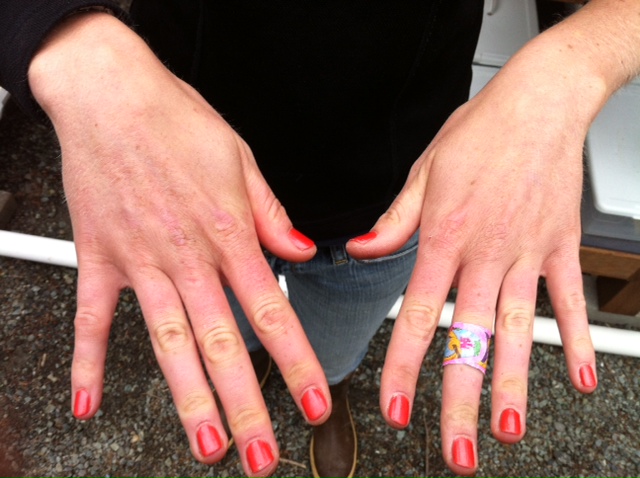
Wedding was Saturday night. This (Figure 1) is Monday morning. The Disney Princess  band-aid (Jasmine?) on the left middle finger was actually preventative. I cut the skin on the inside of that joint, down to the tendons, incidentally, with brand new tin snips the week before, and wanted to protect the healing cut (2). 


T = 1
Figure 2. Hands post-day one. Decidedly less fancy.
By the end of day one (Figure 2), on which I was actually working on carpentry, I have gained a net of one band aid (I evidently tore the skin on my right pinkie pretty badly by scraping it on a plastic valve and have no idea why that index finger was bleeding, but was able to remove the one from the left middle finger) and you'll notice the polish hasn't fared very well.  It starts receding from along the edges and the cuticles, just look at it go!

T = 2
Figure 3.  Wear and tear on fingernails after two days of being a marine biologist.  

On day 2, I was out in the mud, counting snails, and I had so many cuts, I thought it wise to wear a really thin glove on my right hand. The Michael Jackson technique worked, and the nails on my right hand fared pretty well, but we are seeing definite recession of the polish on the left (Figure 3).  This is also evidenced by the dirt under left but not right fingernails.  The only reason I am wearing fewer band-aids, however, is that the glove sucked one off.  


T = 3
Figure 4.  Cleaned hands after Day 3. Note also, healing gash on right pinkie.
I wasn't able to favor my right hand with a cushy glove on day, three, and it shows (Figure 4).  There goes the polish on those fingers as well.   

T = 4
Figure 5.  Cleaned hands after day 4.  My nails really look like crap.
Day 4 was more of the same (Figure 5).  At this point I thought about doing image analysis and mapping the loss of area of painted nail over time.  But I got lazy.  If my pictures were better, it wouldn't be too hard.  

Well at this point I felt badly every time I looked at my massacred manicure, so I took off the polish entirely.

T > 5
Figure 6. Still residual dirt under my nails, but devoid of polish.

Back to plain, old, Emily hands (Figure 6).  But slightly stronger and tougher.  


Ok, I'm sick of looking at pictures of my beat-up hands.  


References and miscellany:
(1) Didn't they just tell us that 3 hours of sitting a day is enough to shorten your life by 2 years!  HOLY SEDENTARY LIFESTYLE! Yes they did. Who can sit for less than 3 hours a day?!
(2) Ok, maybe my clumsiness also contributes to my spate of field injuries.  We are all our own worst enemies. 
(3) Maybe tied with teeth?